

For years, Shopify Stocky has served as the entry-level lifeline for growing merchants. It provided a manageable bridge between basic inventory tracking and the complex demands of multi-location retail. However, for enterprise brands scaling toward high-volume complexity, the bridge is narrowing.
The "sunset" of Stocky isn't necessarily a single shut-off date for the app, but rather a functional decline. As of July 2025, Shopify removed critical operational features: such as inventory transfers between locations and min/max replenishment limits: moving them into the native Shopify Admin. While this centralizes data, it strips away the "intelligence layer" that scaling retailers rely on for demand planning.
For brands like Samsonite, New Balance, or Patagonia, a baseline tool is no longer a viable strategy. Transitioning to a dedicated Shopify Stocky alternative is no longer a "future project": it is a critical requirement for maintaining operational continuity.
Why Stocky is no longer enough for scaling retailers
The core issue is that Stocky was built for the merchant you were, not the enterprise you are becoming. As SKU counts grow and fulfillment networks expand across multiple distribution centers and 3PLs, the structural cracks in Stocky become impossible to ignore.
- Limited Forecasting and Demand Planning: Stocky uses basic historical calculations. It lacks the ability to account for seasonality, marketing campaign spikes, or multi-variable demand signals. For a brand scaling globally, "basic" forecasting is a recipe for catastrophic stockouts.
- The 2,048 Variant Barrier: Shopify recently increased its product variant limit, but many Stocky-based workflows: specifically purchase orders and barcode generation: struggle or break when handling large, complex catalogs.
- Multi-Location Depth: While Stocky can "see" multiple locations, it cannot intelligently manage the flow between them. The removal of native transfer logic in 2025 forced teams back into manual workflows within the Shopify Admin, which lacks the sophisticated replenishment logic needed for high-velocity retail.
- Omni-channel Blindness: Stocky lives exclusively within the Shopify ecosystem. It cannot natively sync or forecast for Amazon, eBay, or wholesale channels, leading to fragmented data and a fractured "source of truth."
The real cost of staying put
Staying on a legacy tool during a period of growth is rarely "free." The costs are hidden, buried in spreadsheets and manual labor. When your inventory system cannot keep pace with your sales velocity, the business pays in margin erosion.
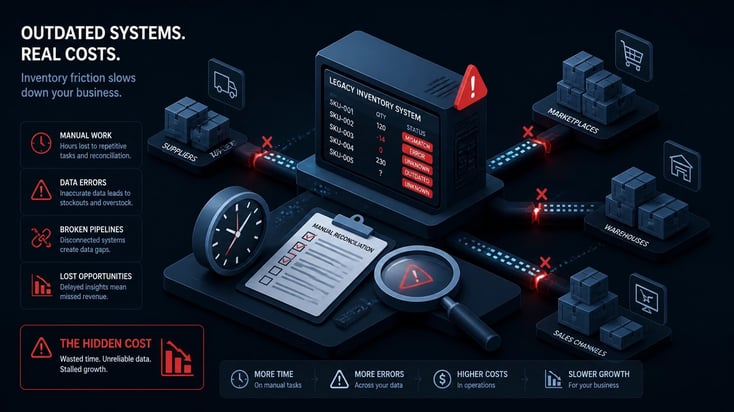
Quantifying the Hidden Costs:
- Stockouts and Overstocks: Without automated safety stock buffers, retailers oscillate between "out of stock" (lost revenue) and "overstocked" (tied-up capital). For enterprise brands, even a 2% improvement in inventory accuracy can represent millions in reclaimed liquidity.
- Manual Reconciliation Errors: When teams are forced to manually export data to calculate reorder points, human error is inevitable. A single typo in a purchase order can lead to months of supply chain headaches.
- Staff Hours and "Spreadsheet Debt": Scaling brands often employ full-time operations managers whose sole job is to "fix" what Stocky can't do. Moving to a more robust Shopify Stocky alternative allows those high-value employees to focus on strategy rather than data entry.
- Inability to Scale B2B: If you are moving into the B2B space: a move we often help brands navigate through our specialized Shopify services: Stocky’s lack of wholesale-specific workflows becomes a direct blocker to revenue.
What a modern inventory operation looks like
A modern enterprise doesn't just track inventory; it orchestrates it. The goal is to move from a reactive state (fixing problems) to a proactive state (automating solutions).

In a high-performing commerce ecosystem, your inventory system should act as the "brain" of the operation. This includes:
- Connected Systems: Seamless integration between your ERP, your WMS (Warehouse Management System), and your Shopify storefront. Data flows in real-time, ensuring that what the customer sees on the site is physically available in the warehouse.
- Automated Replenishment: Systems like Brightpearl or NetSuite use lead-time tracking and sales velocity to tell you exactly when to reorder, accounting for the time it takes for a shipment to cross the ocean.
- Real-time Visibility: Whether stock is in a retail store, a 3PL, or on a container ship, a modern operation has a single pane of glass to view total global availability.
- Intelligent Routing: Automatically fulfilling orders from the location closest to the customer to reduce shipping costs and carbon footprint.
How to evaluate a Stocky alternative
Choosing a replacement is a strategic decision that depends on your specific "pain point." Are you struggling with planning (what to buy) or execution (how to ship it)?
The Buyer’s Criteria Checklist:
- ERP Backbone (NetSuite / Brightpearl): Best for brands that have outgrown their accounting software and need a "system of record" that handles finance, inventory, and operations in one place.
- Multichannel Specialists (Linnworks): Essential if your growth is driven by marketplaces like Amazon or Target+ alongside your Shopify store.
- Warehouse Execution (SKULabs / SKUSavvy): The right choice if your primary bottleneck is pick/pack/ship efficiency and warehouse accuracy.
- Planning Layers (Inventory Planner / Prediko): Sometimes, you don't need a new ERP; you just need a better "brain." These tools plug into Shopify to handle the forecasting that Stocky used to do, but with much higher precision.
While these tools offer immense power, the implementation is where most brands stumble. Consulting help de-risks the choice by ensuring that the platform you choose actually integrates with your existing tech stack without breaking your customer experience.
A migration approach that avoids downtime
Migration is often viewed with trepidation, but it doesn't have to result in operational "darkness." At Red Van Workshop, we utilize a phased migration method that ensures your data remains clean and your fulfillment stays live.

- Audit & Discovery: We analyze your current SKU architecture and supplier relationships to identify what needs to be cleaned before the move.
- The "Parallel Run": We often recommend running your new system alongside Stocky for a set period to ensure data parity before the final cutover.
- Data Integrity: We ensure that historical purchase orders and supplier data: which do not automatically migrate from Stocky: are meticulously mapped to your new system.
- Training & Optimization: A new tool is only as good as the team using it. We provide the technical training to ensure your operations team hits the ground running.
The functional sunset of Stocky is an opportunity to future-proof your business. By moving to a platform built for enterprise scale, you aren't just replacing a tool; you are building a foundation for the next $100M in revenue.
Ready to evaluate your next move? We’re here to help you navigate the complexity of platform selection and migration. Contact us for a migration consultation and let's get your inventory operations moving at the speed of the Autobahn.